
Parrondo’s Paradox

Updated: Feb 2
‘Two wrongs can’t make a right’ is a statement that we always heard of in our day to day life. Well, things get a little complicated when we look at it from the lens of Game Theory. In the arena of Game Theory, two losing strategies that are dependent on each other can surprisingly create a winning strategy when used in a certain combination in longer terms. The concept we are referring to here is Parrondo’s Paradox.
Imagine this with a simple example: You are standing at the crossroads of two roads, both leading in the same direction. One road (say Game A) is your old, congested road and going on it gives you a lower payoff (increasing your time and fuel costs). Another road (say Game B1) is a newly built fast lane road that lowers your time but you have to pay a hefty tax to
travel over it. Or if you don’t want to pay (say Game B2 or no tax B1), you have to maintain a strict speed limit along with increased congestion as compared to Game A and Game B1.
In this scenario, each one is guaranteed to bleed you dry, if you play it long enough. Yet, when you switch between them in a random fashion, your overall chances to decrease your travel time increase and you can have your cup of tea at the place timely. This is at the heart of Parrondo’s Paradox.

In the 1990s, Spanish physicist Juan Parrondo stumbled on this strange phenomenon while exploring a physics thought experiment called the Brownian ratchet — a kind of “complex machine” inspired by ideas from statistical physics. What he discovered had a ripple effect well beyond physics: it showed that losing strategies don’t always have to be losing when they interact in just the right way.
Markov Chains & Mathematical Analysis of Parrando’s Paradox:
Innovated by Russian Mathematician Markov, a ¹Markov Chain is a system that moves between different states (possible situations the system can be in) where the next state depends only on the current one (memoryless). It proves that the dependent events can follow the law of large numbers, given a collection of random variables (latex) (in statistics fashion, stochastic process). For example, suppose you wanted to go to a bookstore to purchase a Marvel Comic. What can happen? Either you do not go into the bookstore (N), he goes to the bookstore but does not buy any books (G) or he goes into the store and buys at least one book (B). These are states. Each state has its probability and the future course of action by you just depends on your current state. It asks you — If I’m in one state today, what are the chances I move to another state tomorrow? Thus it follows a series of transitional probabilities that allow us to decide movement across states. By this it tries to analyse dependency of different games in our Parrondo Paradox and thus bring mathematical backing of higher winning probability through combination of two losing strategies (states).
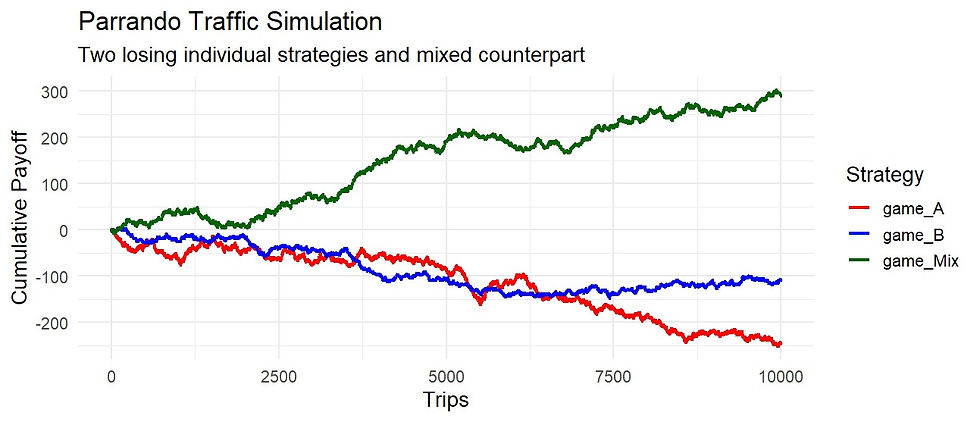
Putting it into a road example, the states are Heavy, Moderate and Light traffic for each game (A,B1 or B2) you choose. Assigning each state a number and associated probability we ran our traffic simulation over 10,000 times using Markov chains as highlighted in the graph. Clearly, using some specific random allocation of game A and B (shown in green line), two losing strategies can be transformed into a winning bagger².
Applications of Parrondo’s Paradox:
Economics: This line of inquiry remains an active area of research. One of the most discussed applications of Parrondo’s Paradox lies in portfolio management. Individually holding poor-performing assets, especially those that occasionally force an investor out of the market, can, when combined in a structured way, outperform expectations. Through state-dependent rebalancing strategies such as “buy low, sell high,” an individual can shift her portfolio into more favorable states over time. However, real financial markets rarely possess the strict state dependence assumed in classical Parrondo games. As a result, the paradox functions more as a conceptual insight than as a direct investment blueprint. Beyond finance, the paradox offers intuition for policy mixing at the macroeconomic level. Although each policy instrument has drawbacks, alternating between monetary and fiscal policies can help stabilize uncertain economies if sequenced in response to macroeconomic states. This reflects a central lesson of Parrondo’s Paradox: outcomes depend not merely on isolated actions, but on order, feedback, and interaction over time.
Population Dynamics: This can be explained through the below flowchart. As illustrated here, each agent’s payoff is not fixed but is a state-dependent expectation shaped by both the sequence of interactions and the network topology linking agents. When two losing interactions are mixed across a heterogeneous network, the first interaction (“agitation”) reshuffles individuals, while the second (“ratcheting”) rewards those who land in favorable local conditions. This process increases the likelihood that agents reach beneficial states, even though each interaction alone leads to decline. Under this paradoxical mechanism, net population growth can emerge from individually harmful dynamics.

Evolutionary Biology: Darwin’s idea of “survival of the fittest” admits ³subtle variations. Parrondo-like reasoning provides a theoretical lens for exploring whether a seemingly inferior survival strategy can outperform a more efficient one over time. This is evident in dormancy strategies: populations alternate between an active state with low growth and a dormant state that cannot reproduce. Each state is individually disadvantaged compared to always-active competitors. Yet the ability to switch enables “dormitive” species to survive catastrophic environmental fluctuations. Once again, what appears to be a losing strategy in isolation can become winning when embedded in a dynamic, state-dependent sequence. Across domains, Parrondo’s Paradox teaches that how processes are combined can matter more than what those processes are. In complex systems, disadvantage can transform into advantage through structure, sequence, and interaction.
Conclusion:
Parrondo’s Paradox leaves us with a powerful and counter-intuitive lesson: in complex systems, consistency is not always strength. Two strategies that are each guaranteed to fail on their own can, when alternated in the right way, generate success. What appears to be chaos reveals itself as a form of hidden order, one that prevents losses from compounding and transforms defeat into advantage.
However, the paradox also comes with important caveats. Its success depends critically on the specific timing, sequencing, and interaction of strategies; slight deviations can lead to failure. Moreover, the systems where Parrondo’s Paradox applies are often highly idealized, and real-world conditions, such as noise, incomplete information, or external shocks can limit its practical relevance. Blindly applying losing strategies in the hope of creating a winning pattern can be risky without careful modeling and monitoring.
Sometimes, the smartest path forward is not to cling to a single “best” option, but to embrace variation, while remaining aware of the assumptions and boundaries that allow variation to produce success. In a world governed by uncertainty, Parrondo’s Paradox teaches us that even losing moves, when combined wisely and strategically, can become a winning strategy, but only when applied with critical understanding
A book we would recommend for understanding basic game theory concepts is The Art of Strategy by Avinash Dixit and Barry Nalebuff. This book is a great resource for anyone willing to learn about game theory. Happy learning!
¹ Ref: csit130603.pdf https://share.google/qYI5HP6E9x1GctGoJ
² Ref: https://gist.github.com/anshika-var886/6f07114958ec026caf0e60c6e8caaa56 The code has simplified probabilities’ assumptions. To align with classical Parrondo examples, we have assigned the same probability of 0.745 to both states 1 & 2. This won't change the application result. However, not all random assignments of probability work.
Other Sources:

Comments